A clinician wrote to Alison Bennett to say that corridor care had become so common they were teaching students and junior doctors how to provide it. Relaying that account to the Commons in July, Bennett warned that an emergency response was becoming an accepted part of medicine.
Three months later, the RCN reported 99,290 recorded instances in England during September. Between those moments, MPs rejected a statutory deadline for ending the practice. Ministers promise to end its routine use before this Parliament finishes.
The Commons has supplied plenty of remedies. The harder arguments concern who funds them, whether NHS reorganisation helps deliver them, and what happens if the Government's promise fails.
This article was prepared by VoxPolitica Editorial using a blend of human research, VoxPolitica's databases, and an AI research agent that uses the VoxPolitica API to analyse parliamentary data. If you'd like to commission in-depth research to support your work, contact us.
The hospital cannot solve this alone
VoxPolitica reviewed 129 indexed contributions from 57 MPs across 30 debate sections, retrieved by “corridor care” in the text or debate title. Within that defined record, discharge and social care appeared in 62 contributions from 36 MPs; preventing admissions in 45 from 31. These are overlapping arguments raised, not votes for a policy or a census of emergency-care debate.
The case extended beyond July's dedicated debate: 26 of the 63 contributions elsewhere raised discharge or social care. MPs repeatedly located part of the hospital's problem in services outside it.
Rachel Taylor supplied a precise example in April. After her father's stroke, he could not obtain equivalent speech and language therapy near home, so he remained in hospital. Her case centred on patient choice and recovery with family; freeing beds was a system implication. Neighbourhood care required therapists able to deliver it.
The wider parliamentary record supplies a more specific equipment proposal. On 7 September, Daniel Francis sought an 18-week requirement for community equipment and wheelchair services, citing inquiry evidence connecting missing equipment with delayed discharge. His argument falls outside the phrase-defined counts, but identifies another practical condition for getting patients home.
The parliamentary attention was concentrated. July's 88 contributions amounted to 1.52% of all indexed Commons contributions that month; 66 came from the 8 July debate. Remove that debate and July's share falls to 0.38%. The chart records a parliamentary occasion, not proof of steadily rising concern.
View exact monthly chart data
- Jan 2026
- 0.064% · 7/10,994
- Feb 2026
- 0.000% · 0/8,147
- Mar 2026
- 0.051% · 5/9,713
- Apr 2026
- 0.075% · 5/6,641
- May 2026
- 0.043% · 1/2,329
- Jun 2026
- 0.066% · 7/10,591
- Jul 2026
- 1.525% · 88/5,772
- Aug 2026
- No recorded denominator
- Sept 2026
- 0.147% · 9/6,119
- Oct 2026 (to 18th)
- 0.242% · 7/2,896
* October ends on the 18th. August is a gap. Denominators include all indexed Commons records, including hearings and procedural contributions. Counts measure recorded activity, not support.
Who pays for care outside hospital?
Danny Chambers tried to turn the familiar promise of community care into a budget rule. His 2 July amendments proposed a primary-care investment standard: integrated care boards would increase primary-care spending at least in line with their overall funding. Otherwise, he argued, patients unable to obtain GP or dental appointments would reach the more expensive A&E department.
Caroline Johnson challenged the trade-off. Without more money overall, protecting one service could squeeze another, including mental health or hospital care. She questioned measuring spending inputs rather than patient outcomes. Karin Smyth answered with existing investment, including an additional £601 million for general practice. Announcing extra money and guaranteeing a service's future budget share are different commitments.
The Health Bill exposed another disagreement. Helen Morgan challenged changes to joint planning and the better care fund; Chambers also argued that the Bill risked weakening NHS–council cooperation, precisely when discharge required it. Smyth rejected that reading: the fund would remain central, voluntary pooled budgets would remain possible, and ministers needed flexibility. The dispute was over how to secure integration, with the Liberal Democrats seeking stronger guarantees around joint working.
MPs also differed over financial incentives. Simon Opher tentatively suggested charging community services when discharge-ready patients remained in hospital. Morgan's £1.5 billion proposal would fund 6,000 beds across hospital and social care, alongside discharge packages and support for carers and hospices. One approach sought to change organisations' incentives; the other explicitly sought more capacity across the system.
Capacity remained the constraint on the proposed shift. Rebecca Long Bailey welcomed virtual wards but demanded staff to run them. Jayne Kirkham warned that discharge without rehabilitation could bring patients back.
Clearing a corridor can move the queue
Matt Turmaine offered Watford as a practical success: whole-hospital responsibility, real-time bed information and coordination with paramedics and social care. He reported six months without corridor-care incidents. That period and its recording definition have not been independently verified here. His example made the case for acting before national reform arrived, without establishing that every trust could reproduce the result.
Edward Argar's 9 July challenge was about what a target might displace. A hospital could avoid corridor congestion by leaving patients in ambulances, tying up crews needed elsewhere. Morgan accepted the concern but called it manageable, citing improved ambulance handovers under new management locally. Eliminating one queue requires watching the others.
Protecting patients without accepting the corridor
Smyth defended named nursing responsibility, senior clinical oversight and monitoring, explicitly rejecting normalisation. Bennett's warning about habitual acceptance can coexist with those protections. The difficulty is how to equip staff for a setting ministers promise to eliminate.
HSSIB found that fear of normalisation could itself obstruct safety. Some hospital leaders avoided installing emergency call bells or electric points; others adapted spaces because patients were already there. Refusing the equipment did not remove the need to treat those patients. Installing it did not make the corridor an appropriate permanent ward.
The RCN recognised guidance's value while demanding a funded eradication plan. The question for ministers is how safeguards connect to progress towards elimination. A safer temporary arrangement and a credible route out of it are both required by the positions MPs put on record.
A promise Parliament could enforce
Morgan pursued that distinction through the Health Bill. Her July proposal required annual reporting and ministerial evidence before affected patients and staff. Johnson questioned a new tribunal when the Health and Social Care Committee already scrutinised ministers. This was a dispute about who should hold ministers accountable, beyond agreement that patients should be heard.
Accountability and deadlines appeared in 28 of the 63 contributions outside the dedicated July debate, compared with 12 of 66 within it. Committee scrutiny repeatedly tested the means of enforcing the ambition aired in the Chamber.
In September, Morgan sought a firmer obligation: end corridor care within one year of the Bill passing, or face an independent inquiry. The Commons defeated the clause by 300 votes to 79 on 8 September. Smyth preferred existing legal structures and operational action: better discharge, urgent-care capacity and targeted help for struggling trusts.
The Government's answer has since acquired a larger social-care commitment. On 15 October, Alison McGovern announced preparations for a national care service with free personal care, with Casey due to report next summer. She said action could not wait for the review. The announcement does not by itself establish that additional discharge places have been secured, or when patients will be able to use them.
That leaves hospitals needing discharge support while the new service takes shape. Ministers retain their end-of-Parliament promise; the Commons declined to put Morgan's earlier deadline and inquiry trigger into the Bill. The coming winter will test the operational programme they defended instead.
The contributions behind the argument
The counts cover the 129 phrase/title matches. The comparison table selects 24 contributions around four policy questions, pairing mechanisms with challenges and replies through October. The MP ranking is confined to the original search. Definitions and every counted source are inspectable below.
| Argument | Contributions | MPs |
|---|---|---|
| Discharge and social care | 62 | 36 |
| Patient harm and safeguards | 61 | 32 |
| Hospital capacity and workforce | 59 | 35 |
| Preventing admissions | 45 | 31 |
| Accountability and deadlines | 40 | 24 |
| Measurement and transparency | 28 | 18 |
| Normalisation and adaptation | 27 | 19 |
Counts record arguments raised, including questions and rebuttals, rather than support. One contribution can raise several arguments; 14 contain no distinct qualifying argument. Interrupted speeches can produce several contributions.
Purposive selection: for each issue include an explicit proposal, a material challenge or qualification and the relevant government response; add distinct evidence or consequences. Speakers repeat only for a different mechanism or direct reply. Seven rows come from 8 July; four are from September/October. Sources include full surrounding debates and wider searches. These examples are not a representative sample or the denominator for the argument counts.
Function describes the reasoning. “Stated basis” identifies what the MP offers for that argument, not whether it proves the claim. Experience, local reports, statistics, legal texts and proposed allocations are distinguished; professional status alone is not evidence.
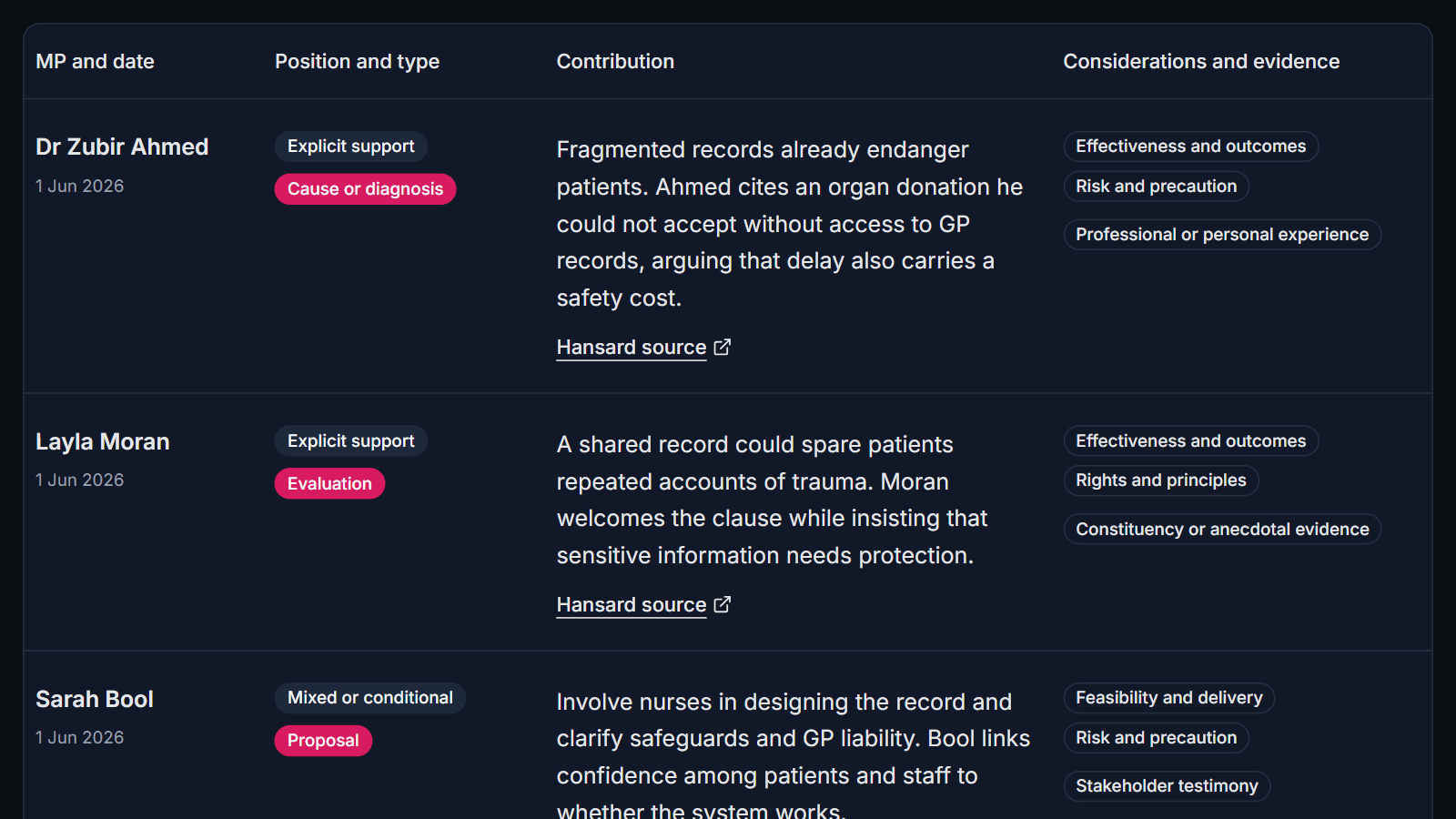
Chambers sought a protected funding rule; Johnson questioned its opportunity costs, and Smyth defended existing investment. Other contributions specify beds, staff, equipment and rehabilitation, or argue for operational improvements before national reform.
Dr Danny Chambers
2 Jul 2026
Protect primary-care spending growth
Chambers sought a primary-care investment standard so ICB spending would grow at least with total funding. He argued that poor GP and dental access transferred patients to the more expensive A&E service.
Reasoning
Stated basis
His amendments and the RCGP practice-manager survey. These support the funding case; they do not independently establish the proposed standard's savings.
Dr Caroline Johnson
2 Jul 2026
Test the spending trade-off
Johnson questioned what protected primary-care funding would take from hospital or mental-health services without more money overall. She favoured attention to outcomes and changing local need over a fixed spending allocation.
Reasoning
Stated basis
She cites Darzi on primary care's efficiency, then reasons about competing demand and budgets. Her objection is to the allocation rule and input measure, not to primary care itself.
Wider search · outside counted set
Karin Smyth
2 Jul 2026
Point to existing primary-care investment
Smyth answered the investment-standard proposal with existing increases for general practice, pharmacy and other primary services. Those figures defended the spending record; they did not enact a guarantee about primary care?s future budget share.
Reasoning
Stated basis
Government funding totals, including an additional £601 million for general practice. Spending announcements do not themselves demonstrate reduced corridor care.
Surrounding debate · outside counted set
Helen Morgan
8 Jul 2026
Fund beds and discharge capacity together
Morgan proposed £1.5 billion for 6,000 beds across hospital and social care, alongside step-down packages and support for carers and hospices. Her case joined acute capacity to the services needed for safe discharge.
Reasoning
Stated basis
Her speech cites royal-college reports, waiting-time figures and a constituent's experience. The £1.5 billion is a proposed allocation, not an independently validated costing of the package.
Rebecca Long Bailey
8 Jul 2026
Staff virtual wards and community care
Long Bailey welcomed hospital-grade care at home but challenged virtual wards without staff to deliver them. She sought a funded workforce plan and community nursing, rehabilitation and publicly accountable social care.
Reasoning
Stated basis
She describes accompanying her mother to A&E and staff accounts of bed and workforce shortages. Those experiences motivate her staffing argument; they are not an evaluation of virtual wards.
Rachel Taylor
23 Apr 2026
Provide rehabilitation and choice near home
Taylor described her father remaining in hospital because therapy was unavailable near home. She emphasised patient choice and recovering with family, explicitly distinguishing that goal from simply freeing hospital space.
Reasoning
Stated basis
Her father's stroke recovery and lack of equivalent speech and language therapy near home. It is an individual family experience, not a national delayed-discharge estimate.
Daniel Francis
7 Sept 2026
Set a deadline for equipment provision
Francis proposed an 18-week requirement for community equipment and wheelchair services. He linked missing equipment to delayed discharge and inconsistent ICB accountability, making the home-care capacity argument a specific service obligation.
Reasoning
Stated basis
APPG inquiry findings and his daughter's wheelchair experience. The reported survey links unavailable equipment with delayed discharge; it does not measure the amendment's eventual effect.
Wider search · outside counted set
Matt Turmaine
8 Jul 2026
Improve whole-hospital coordination now
Turmaine described whole-hospital responsibility, real-time bed information and coordination with paramedics and social care. He reported six months without corridor-care incidents at Watford; this remains his account, not proof every trust can reproduce it.
Reasoning
Stated basis
Watford's reported operational approach and six-month record, relayed by its MP. The recording definition and full six-month result have not been independently verified here.
Jayne Kirkham
8 Jul 2026
Keep rehabilitation in the discharge plan
Kirkham supported community alternatives but warned against discharge without rehabilitation, which could send patients back to hospital. She also cautioned that faster ambulance release could shift pressure into emergency departments.
Reasoning
Stated basis
Cornwall's out-of-hours GP, clinical advice and falls-response services are cited as examples. Her readmission warning is a predicted consequence, not a measured effect of the proposed reforms.
Morgan and Chambers sought stronger integration guarantees. Stafford questioned both accountability under delegation and the force of a review without mandatory follow-through. Smyth defended existing review powers and flexibility over pooled budgets.
Helen Morgan
30 Jun 2026
Retain joint health and social-care planning
Morgan challenged abolishing integrated care partnerships and changing local representation and the better care fund. She argued that separating responsibilities threatened the cooperation needed for discharge; this was her criticism of the Bill's design.
Reasoning
Stated basis
Sir Andrew Dilnot's committee evidence and Shropshire's financial pressures. Her interpretation of the Bill's effects is contested by ministers.
Dr Danny Chambers
30 Jun 2026
Review and strengthen pooled-budget arrangements
Chambers supported a statutory review of section 75 arrangements. He argued that disputes over which organisation pays frustrate discharge and admission prevention, and that the Bill should do more to support pooled budgets and joint commissioning.
Reasoning
Stated basis
Committee findings, ADASS testimony and section 75 arrangements. The sources identify integration obstacles; they do not establish every pooled budget's effectiveness.
Gregory Stafford
30 Jun 2026
Clarify responsibility and require follow-through
Stafford welcomed collaboration but asked who would answer for pooled spending and service failure. He also argued that the proposed review lacked force because ministers would only have to consider changes, without implementing them.
Reasoning
Stated basis
His reading of clause 39 and new clauses 20 and 26. The accountability risks are his assessment of the proposed arrangements, not established service failures.
Wider search · outside counted set
Karin Smyth
30 Jun 2026
Use the existing review and delegation framework
Smyth said section 75 could already be reviewed without new law and that work was continuing. She rejected the separation claim and explained responsibility under delegated functions, arguing that a single statutory review would duplicate ongoing work.
Reasoning
Stated basis
The Department's 2023 review, continuing work and the allocation of liability/accountability under the framework. These are the minister's grounds for rejecting another statutory review.
Surrounding debate · outside counted set
Karin Smyth
2 Jul 2026
Retain pooling with greater ministerial flexibility
Smyth said the better care fund remained central and voluntary pooled budgets would continue. She defended flexibility over when pooling was required and said directions would be published, rejecting the claim that the changes weakened joint working.
Reasoning
Stated basis
The Bill's financial powers and continuing voluntary section 75 pooling. Her promised publication of directions is an accountability mechanism, not evidence that outcomes have improved.
Wider search · outside counted set
Morgan proposed new scrutiny and a one-year legal deadline. Johnson preferred existing committee scrutiny; Argar warned about ambulance displacement. Smyth defended action under existing law. October’s care-service announcement supplies later policy context, not proof of delivered capacity.
Helen Morgan
9 Jul 2026
Require reports and direct patient/staff scrutiny
Morgan wanted annual corridor-care reports and ministerial evidence before affected patients and staff. She argued that repeated winter statements had failed to secure progress and that ministers needed to hear the personal consequences directly.
Reasoning
Stated basis
New clause 12's reporting and panel requirements. The design supplies a proposed scrutiny mechanism, not proof that a tribunal would reduce corridor care.
Dr Caroline Johnson
9 Jul 2026
Use the existing parliamentary committee
Johnson said an elected, politically balanced select committee already existed to scrutinise the Department. She questioned duplicating it with a tribunal, while recognising the value of patients' voices and challenging the Bill's abolition of Healthwatch.
Reasoning
Stated basis
The existing Health and Social Care Committee's scrutiny role and the new clause's drafting. Her objection concerns institutional duplication, not the objective of ending corridor care.
Edward Argar
9 Jul 2026
Avoid shifting the queue into ambulances
Argar warned that focusing on hospital corridors could leave patients in ambulances and tie up crews. He accepted the importance of social care and discharge but questioned whether the proposed duties adequately reflected the whole system.
Reasoning
Stated basis
His ministerial experience of delayed discharge and bed availability. He forecasts a response to a narrower target; the speech does not estimate how often that response would occur.
Helen Morgan
9 Jul 2026
Treat ambulance displacement as manageable
Morgan acknowledged Argar's concern but called it manageable. She cited improved handovers after management focused on A&E, arguing that the risk did not invalidate stronger obligations to reduce long waits.
Reasoning
Stated basis
Improved ambulance handovers under new management at her local hospital, as she reports them. A local example does not independently validate the national legislative scheme.
Helen Morgan
8 Sept 2026
End corridor care within one year or investigate failure
Morgan sought a one-year duty to end corridor care, with an independent inquiry into government handling if it failed. This specific enforceable timetable went beyond ministers' end-of-Parliament commitment.
Reasoning
Stated basis
Morgan's official Hansard passage and new clause 140. The duty and inquiry are proposed legal mechanisms; the later division establishes their rejection, not MPs' views on elimination generally.
Official Hansard passage · outside counted set
Karin Smyth
8 Sept 2026
Work within existing law and operational oversight
Smyth opposed adding detailed statutory obligations and defended action through existing structures: better flow, discharge, urgent-care services and targeted trust support. She reaffirmed elimination while rejecting the proposed legislative approach.
Reasoning
Stated basis
Existing legal structures and named trusts' zero-incident reporting, cited by Smyth. Those examples do not establish nationwide eradication or the adequacy of every existing duty.
Alison McGovern
15 Oct 2026
Prepare a national care service while acting now
McGovern announced preparations for a national care service with free personal care, with Casey due to report next summer. She said action could not wait, linking social-care failures to hospital pressure; the statement did not establish delivered discharge capacity.
Reasoning
Stated basis
Her ministerial statement announces workforce and technology measures alongside future reform. It does not demonstrate that additional discharge places have been secured.
Commons division, 8 September
New clause 140 was defeated by 300 votes to 79. That records rejection of the particular duty and inquiry trigger; it does not show 300 MPs opposing the elimination of corridor care.
Read the sourceBennett warned about habitual acceptance; Smyth defended immediate safeguards and also rejected normalisation. Allin-Khan described the limits of dedicated nursing in a corridor. These positions can coexist: none establishes a desire to keep corridor care.
Alison Bennett
8 Jul 2026
Prevent temporary adaptation becoming routine acceptance
Bennett relayed a clinician's account that students and junior doctors were being taught corridor care. She warned about accepting an unsafe norm and sought investment in staff, capacity and social care; she did not advocate withholding immediate safeguards.
Reasoning
Stated basis
Constituent experiences and staff accounts, including one clinician's report of teaching corridor care. These are attributed accounts, not evidence of a national training policy.
Karin Smyth
8 Jul 2026
Protect patients now while ending routine use
Smyth defended senior clinical oversight, named nursing responsibility and monitoring wherever temporary spaces could not immediately be avoided. She also rejected normalisation and promised to end routine corridor care before Parliament finished.
Reasoning
Stated basis
National guidance on clinical oversight, named nursing responsibility, monitoring and escalation. These standards prescribe protection; their existence is not proof that every corridor meets them.
Dr Rosena Allin-Khan
8 Jul 2026
Recognise the limits of care in a corridor
Allin-Khan described dedicated nurses checking observations and pain relief at St George's, yet argued that a corridor still denied patients privacy and dignity. Her account shows why immediate clinical effort and ending the setting remain compatible demands.
Reasoning
Stated basis
Her description of nurses caring for corridor patients in her own St George's A&E department. Professional experience supports the account; it is not an independently measured national effect.
HSSIB, 8 January 2026
Some hospital leaders avoided emergency call bells or electric points because they feared normalisation; others adapted spaces to protect patients already there. This external investigation explains the practical tension. It is not an MP contribution or part of the parliamentary counts.
Read the source- Rank 1Helen Morgan
- Contributions
- 7
- Debate sections
- 7
- Active dates
- 7
- Rank 2Dr Danny Chambers
- Contributions
- 4
- Debate sections
- 4
- Active dates
- 4
- Rank 3Karin Smyth
- Contributions
- 3
- Debate sections
- 3
- Active dates
- 3
- Rank 4Dr Caroline Johnson
- Contributions
- 4
- Debate sections
- 2
- Active dates
- 2
- Rank 4Alison Bennett
- Contributions
- 2
- Debate sections
- 2
- Active dates
- 2
- Rank 4Sojan Joseph
- Contributions
- 2
- Debate sections
- 2
- Active dates
- 2
1 January–18 October 2026. These six MPs have the broadest record among the 36 who raised discharge or social care in the phrase/title-defined set. This is not a ranking of all Commons activity on discharge reform. Includes ministerial replies; activity does not establish support or influence. Ties are ordered by active dates, then contributions, then name.
Inspect definitions and all 129 records
Count each source once for each assigned family; codes overlap. An empty assignment means no distinct qualifying argument. Source IDs identify split contributions, not whole speeches. These records allow the published totals to be reconstructed; they are not an independent audit of the coding.
- S: Patient harm and safeguards
- Concrete patient harm, dignity/privacy, infection/equipment/monitoring risks or proposed immediate safeguards. Mere unacceptable/undignified labels without developed reasoning do not qualify.
- C: Hospital capacity and workforce
- Explicit hospital bed/space/staff quantity, senior clinical deployment, diagnostic capacity, capital/estate shortage or related investment. A corridor being clinically unsuitable alone does not qualify.
- D: Discharge and social care
- Explicit delayed discharge, step-down/rehabilitation/care packages, care capacity or NHS/social-care integration connected to corridor care or urgent-care flow.
- P: Preventing admissions
- Explicit primary/community/public-health/mental-health or urgent-treatment alternatives, avoiding admission/readmission or reducing emergency-department demand.
- M: Measurement and transparency
- Definition, collection, publication, completeness/quality/comparability of corridor/long-wait/harm data. Mere citation of statistics or internal bed-management tools is insufficient.
- A: Accountability and deadlines
- Explicit timed elimination/delivery commitment or demand, statutory duty, tribunal, inquiry, regulator/board/ministerial oversight or specific scrutiny mechanism. General urgency/blame and untimed aspiration are insufficient.
- N: Normalisation and adaptation
- Explicit normalisation, routine/inevitable versus exceptional practice or staff/institutional adaptation. General condemnation is insufficient.
145 phrase/title matches, excluding fourteen procedural records and two bundled witness records, leave 129. Excluded IDs and reasons are in the download. The category counts describe this search; they do not estimate every parliamentary argument about emergency care.
Counts: Commons phrase/title query “corridor care”, 1 January–18 October 2026, retrieved 18 October. Of 145 matches, fourteen procedural and two bundled witness records were excluded. All 129 remaining records were manually coded into overlapping families; fourteen had no distinct qualifying argument. Interrupted speeches can count several times. Monthly denominators include all indexed Commons records, including hearings and procedure; August has none, October ends on the 18th. These are not shares of ordinary political debate. Wider searches for discharge, temporary spaces, long waits and legislative instruments were checked on 19 October within the same dates. They inform the purposive comparison, not the counts; additional sources are labelled. Morgan's September proposal uses official Hansard where the indexed passage is incomplete. Party labels are omitted. NHS experimental figures count reported instances, not unique people or every episode; definitions and thresholds differ across settings. Chart values; argument totals/ranking; coding index and definitions.